

By Jim Lewis, CEO Enhanced Retail Solutions LLC
Most of our clients have a common pain point. With so many platforms to sell on- and channels within each platform- they are struggling to manage inventory effectively. Buying the right amount, and moving inventory around to cover each demand pipeline requires a lot of resources. Amazon in particular is perplexing because they can buy direct, indirectly or enable their suppliers to drop ship. To reduce lost sales, you need a sound strategy and the tools to help implement it.
Managing Multiple Inventory Locations
Keeping track of the different distribution points and pipelines is tricky. Within a platform, there may be inventory in multiple distribution centers, individual stores, e-commerce warehouses and even virtual locations. Allocation models vary significantly among retailers. Some silo inventory only for its intended channel while others will move inventory to satisfy any demand from any channel that needs it. But because every retailer does it differently and has different “buckets”, ERP and off the shelf demand planning systems don’t provide the visibility a wholesaler needs.

One page view of where both retail and wholesale inventory is located
Integrating wholesale inventory (ATS- available to sell) and factory orders (WIP- work in process) adds another layer of complexity. Not to mention coming up with realistic sales estimates for each platform and channel. To solve these pain points, wholesaler planners generally turn to spreadsheets. It can work if you are only managing a few sku’s. But if you have hundreds or thousands of sku’s, it’s not the best tool for this type of work.
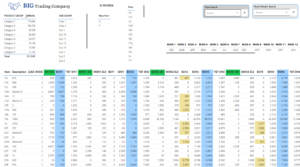
Forecast by month showing beginning and ending inventory, estimated sales and recommended buys
Many Moving Parts
There is a lot of logic, forecast parameters and business rules that need to be taken into consideration. You need a strong back end to store all the point of sale (POS) data using an architecture that will facilitate integration and provide speed. But what makes or breaks any solution is the front end- the interactivity with the planner. It needs to provide them with the information they need, how they want to see it. It should not only present data but include intelligence and recommendations. It should get them as far along in the process as possible. What I mean by that is it should give the final answer- in this case- what to buy, how much and when. And it should be presented in such a manner that a simple export can be fed into a purchasing system. Wouldn’t that save everyone time and money?
Our approach to this problem is to use a hybrid system. We use our intelligent retail.net platform to manage product attributes, seasonality profiles, forecast parameters, security and logic. That connects to Microsoft PowerBI which enables us to customize the views, reports and functions to each and every client. This provides a huge advantage over off-the-shelf demand planning systems that aren’t that flexible and expensive to customize.

The Update Items management tool is essential to manage forecasting parameters and attributes
By visualizing the inventory, sales and recommended buys for each platform and channel, the planner has all the views they need at their fingertips. And changing views, logic and other components is easy and doesn’t carry a high price tag.
Benefits and Role of AI
Other benefits include an interface that can include maps and more interactive chart and graph visuals that spreadsheets don’t have. Access can be shared across multiple organizations. This provides suppliers and retailers visibility to the whole inventory picture which enables more cohesive collaboration.
Finally, AI can play a practical role in virtually every component we talked about here. From automating data ingestion to pinpointing opportunities or liabilities in the data that would otherwise go unnoticed. The predictive model can be enhanced with AI by interjecting outside influences to continually fine tune projections and buy recommendations.
Comments are closed