
By Ramotalahi Aderoju, ERS Business Analyst Intern
The Urgency of Inventory Reassessment Amid Tariff Disruptions
The recent tariffs imposed by the Government on countries including Canada, China, and Mexico have brought much anxiety to retailers and manufacturers. The balance between protecting our national interests and an all-out trade war leaves much uncertainty on the outcomes of these changes. This unpredictability has compelled inventory planners to reassess and adapt their planning processes for imported goods.
The on-again, off-again disruptions have already contributed to delivery delays of goods due to customs holds on foreign shipments. It is becoming ever more difficult to estimate the date on which the consumer will receive their shipment. Previously, goods worth less than $800 were exempt from the provisions until a new 10% tariff on imported goods from China took effect on February 4th. Only to be reversed three days later. Developing strategies to mitigate risks associated with supply chain uncertainties is now a priority.
Growing Concerns Behind Tariff-Induced Supply Chain Shifts
There have been a multitude of methods to curb the effects of tariffs and trade wars in the past. These efforts mainly focus on stockpiling inventory and re-evaluating procurement and inventory practices. Some major fashion companies plan to revamp their operations by shifting production locations to avoid high tariffs, while others explore legal loopholes, such as reclassifying a product’s country of origin. Moreover, major tech company, Sony, is increasing its inventory levels to avoid future cost hikes from a potential provision affecting Japan. Small business founder of Whim, Vivian Hoffman, stated in regards to order planning that “Even in a bad economy, at least for me, I want to do with my own store is just to curate the best possible selection. If I don’t have control over some of the pricing, at least I have control over the selection.”
If You Can’t See It, You Can’t Fix It
The first step in improving inventory flow and making decisions on how, when and where to move inventory begins with full visibility to the supply chain. But many companies lack the resources and tools to do it in a meaningful way. A multitude of spreadsheets isn’t a great way to “see” where all the moving pieces are. To accurately track product locations—whether in domestic or international warehouses, in transit, or held at customs- you need to “bucket” inventory and show them separately. This provides the ability to adjust import orders, move products between warehouses and make other adjustments accordingly to meet demand and minimize disruptions.
Solutions
These practices are best exemplified by Enhanced Retail Solutions’ emphasis on leveraging the integration of POS (Point-of-Sale) data with wholesale inventory from ERP and other 3rd party data points. Combining technology with ERS’ decades of inventory planning experience provides a valuable resource for both large and small companies. Businesses must not only track inventory data but also synthesize it into actionable insights. By analyzing sales trends, stock levels, and supply chain bottlenecks, companies can make proactive decisions that mitigate risks associated with tariff unpredictability. Strategic inventory management is no longer just about storage, it is about foresight, agility, and adaptability in an uncertain global market.

Visualize POS trends and track inventory throughout the supply chain.
Getting the Best Out of the Worst Scenario
While strategic inventory management is essential in today’s uncertain trade environment, the real advantage lies in leveraging data-driven tools to stay ahead. ERS provides businesses with cutting-edge solutions that transform raw data into actionable insights, helping them navigate disruptions with confidence.
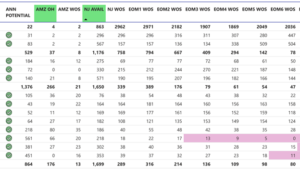
Views of both Retail and Wholesale Inventories with a projection of how much will be owned by month.
How ERS Transforms Data into Actionable Insights
Predicting demand is the starting point in the inventory planning process. While many retailers provide their suppliers with a forecast, it is not always accurate. The supplier is expected to maintain the flow of product to the retailer and often presents great risk. ERS provides the ability for suppliers to create their own forecast and compare it to the retailer’s. They can then decipher which model would most accurately reflect demand trends and inventory needs. The tools not only offer insights into which products are trending up or down but also provide comprehensive views of both retail and wholesale inventories.

One page view of where both retail and wholesale inventory is located
This integration provides visibility into the various stages of production or where finished goods are located. Additionally, dashboards can track items in transit, offering updates on their expected arrival times. With these tools, the user can easily understand their inventory positioning across the supply chain, making it easier to manage stock levels, plan shipments, and ensure timely deliveries to meet demand.
Comments are closed