By Jim Lewis, CEO Enhanced Retail Solutions LLC
That’s a hard thing for me to write since reporting has been a part of our repertoire for the last 25 years. But the truth is we always focused on solutions that answer questions and implemented recommended actions. We have improved on that goal year after year. We were probably too early when we started working with AI ten years ago with our Retail Narrative. The idea was to bubble the most important things happening in your business to the top, click on a button and get a forecast, store allocation, etc. to immediately act on.
That was a paradigm change from combing through spreadsheet-based reports looking for things. We thought it would be great for inventory planners but turns out the sales account managers found it more useful- it gave them actionable things to talk to the buyer about. And unfortunately for many employees, the CEO loved it because it would show some opportunity or liability that no one on the staff had time to find or research.
The AI Factor
Today, users are becoming more comfortable with AI and are looking for ways to incorporate it into their work process. We’ve baked it into many of our solutions to offer a seamless experience to users. For example, a forecast isn’t so mechanical anymore. AI gets a “feel” for an item- it’s volume, maturity, sensitivity to pricing, seasonality, relationship to other items, etc., then determines the most appropriate model. Then it can simply present the user with a list of items, quantities and dates to place at the factory. Granted, a good inventory planner will want to see the details to make sure they are comfortable with it, but over time, confidence will rise and the true benefit of it will be realized.

AI generated item summary embedded in POS performance tracking. It also includes recommended actions.
Another example is performance tracking. Both retailers and suppliers are used to looking at a battery of reports to see what’s selling, what isn’t and what they should buy more of or get out of. The question is how long that process will stay in place. Why read a report if you can simply ask AI those same questions and just get the recommended actions. Want an executive summary? Store-level allocation recommendations? Lost-sales tracking and prevention recommendations? It goes on and on. AI can help. But getting there is anything but easy.
Retail Narrative Agent
That’s why we are taking our Retail Narrative and adding an agent where a user can do more than just chat with their data. Our agent will have ERS’ 25+ years of experience baked into it. It will already be connected to a client’s POS and ERP data (read: no uploading of data). In a nutshell, it will combine a structured retail data layer with specialized analysis workflows. All of which can be curated specifically for each client’s business and retail philosophy. It will know which data points to use to answer questions. For example, a store allocation analysis can consider warehouse availability, store-level performance, product demand and distribution constraints. Just ask the Retail Narrative Agent to provide an allocation. The output isn’t limited to a chatbot response. Users will get:
- Formatted HTML executive summaries
- Downloadable Excel workbooks
- Detailed inventory and sales forecasts
- Store-level allocation recommendations
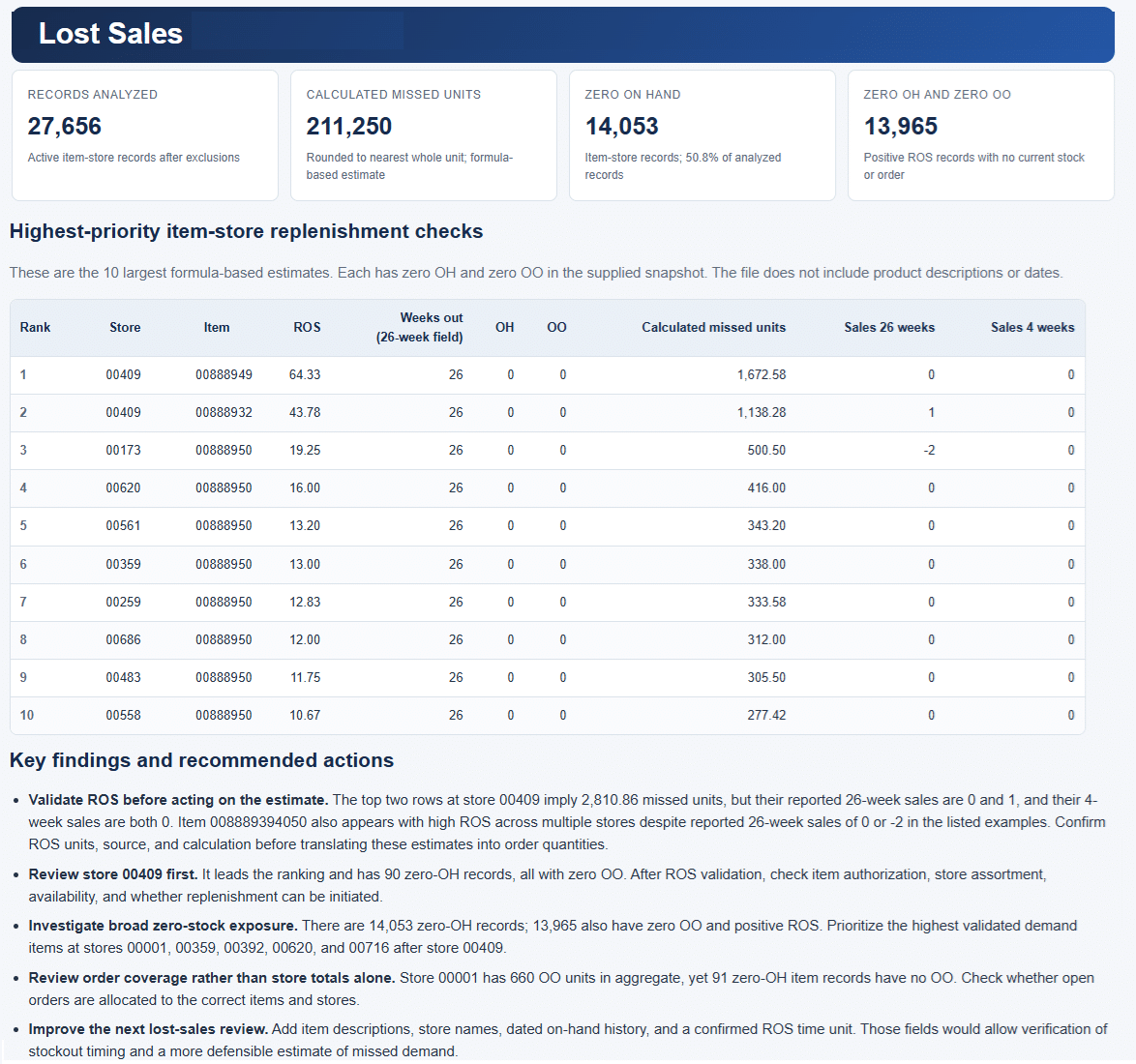
- Lost-sales opportunity analysis
- Supporting calculations and business recommendations
The objective is to eliminate the need to manually build a new report every time a different business question arises.
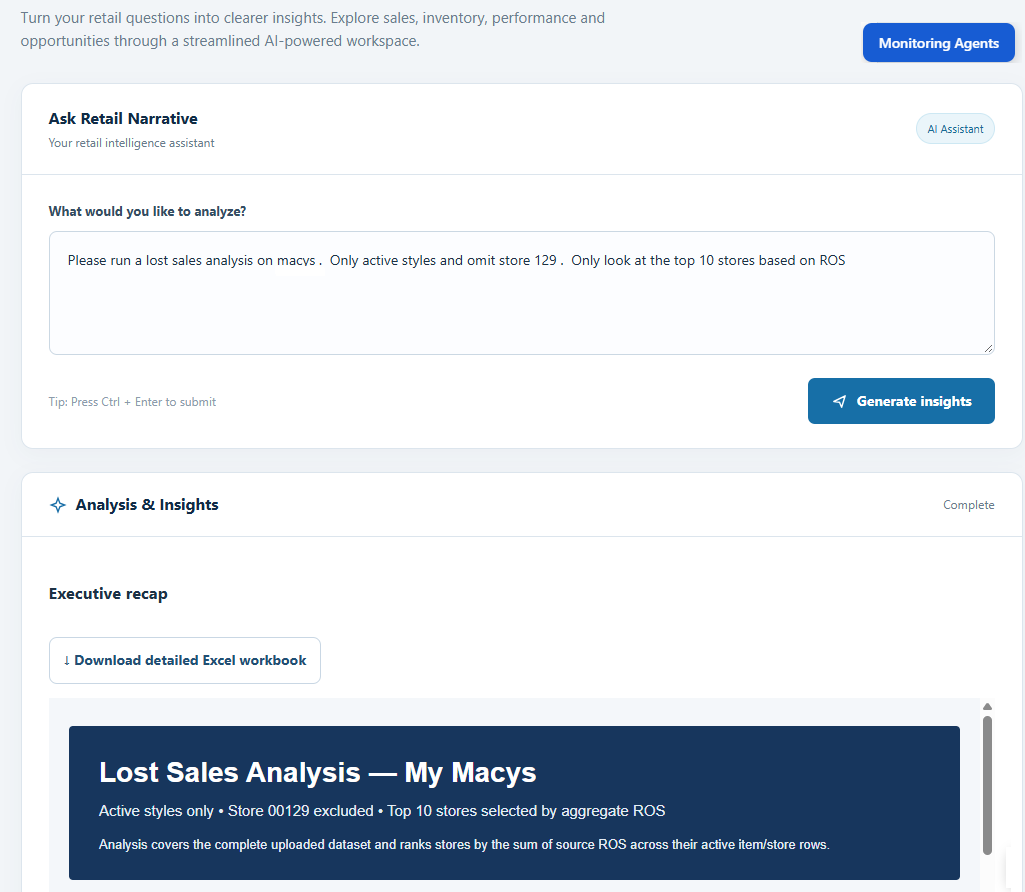
Coming soon: Retail Narrative AI Agent can answer retail and wholesale planning questions
Perhaps the most compelling part about it is autonomous retail monitoring. The agent will investigate inventory and sales performance proactively. Rather than waiting for someone to ask a question, the agent can be configured to monitor a particular segment of the business (brand, category, retail account, etc.). Maybe it will find products that are approaching stock-out conditions. It can then identify the stores most affected, estimate the potential sales impact and recommend actions.

Retail Narrative AI agent can monitor your business and alert you when action is required. Maybe an item is about to run out of stock- it will tell you.
This is only the beginning but as it develops and workflows start to change why do you even need reports? It’s not going to happen overnight, but those that get on it early will reap the benefits far greater than others. It can provide a significant competitive advantage. Stay tuned, more to come.
Comments are closed